01 · Current way
AI can only retrieve what one tool holds.
Every feature you bolt on reasons over a fraction of the company. The model never sees the whole record.
Custom AI operating systems · $2M–$10M companies
Map every workflow before you touch a tool. One write path per entity. Four agents, intake always first. Frontier models only for reasoning.
The internal Boom doc, given away as-is. Tools change weekly. The system is the asset.
From the Boom build, as written
The problem
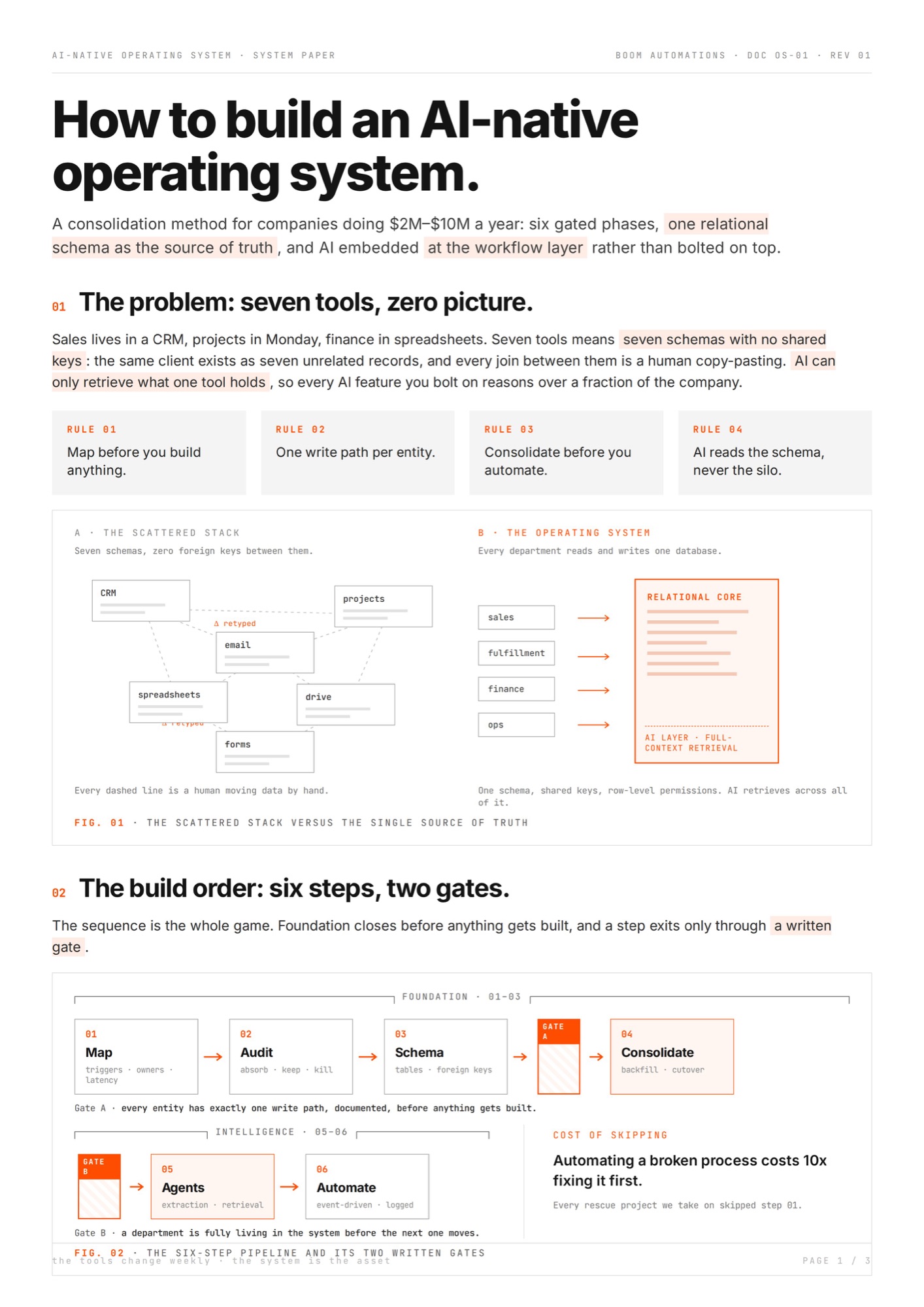
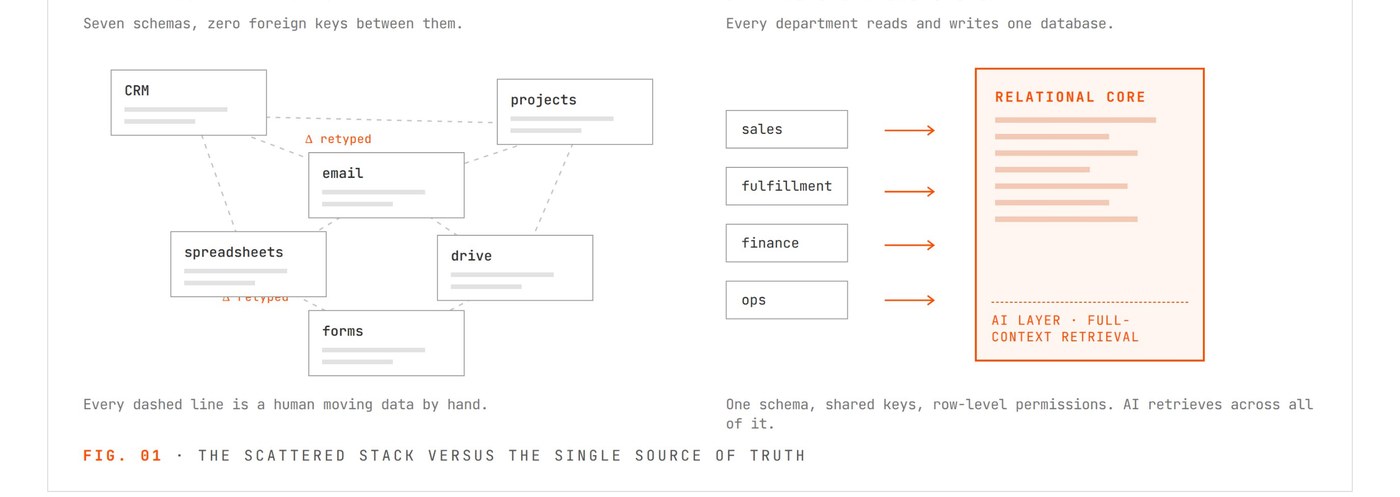
Sales lives in a CRM, projects in Monday, finance in spreadsheets. Seven tools means seven schemas with no shared keys: the same client exists as seven unrelated records, and every join between them is a human copy-pasting.
Every feature you bolt on reasons over a fraction of the company. The model never sees the whole record.
Typical stack in this range: 7–12 tools, 10–25 duplicate key-ins, 2–4 handoffs per workflow. None of it shares a foreign key.
Every rescue project Boom takes on skipped the map. Agents on a silo just make the mess faster.
The new way
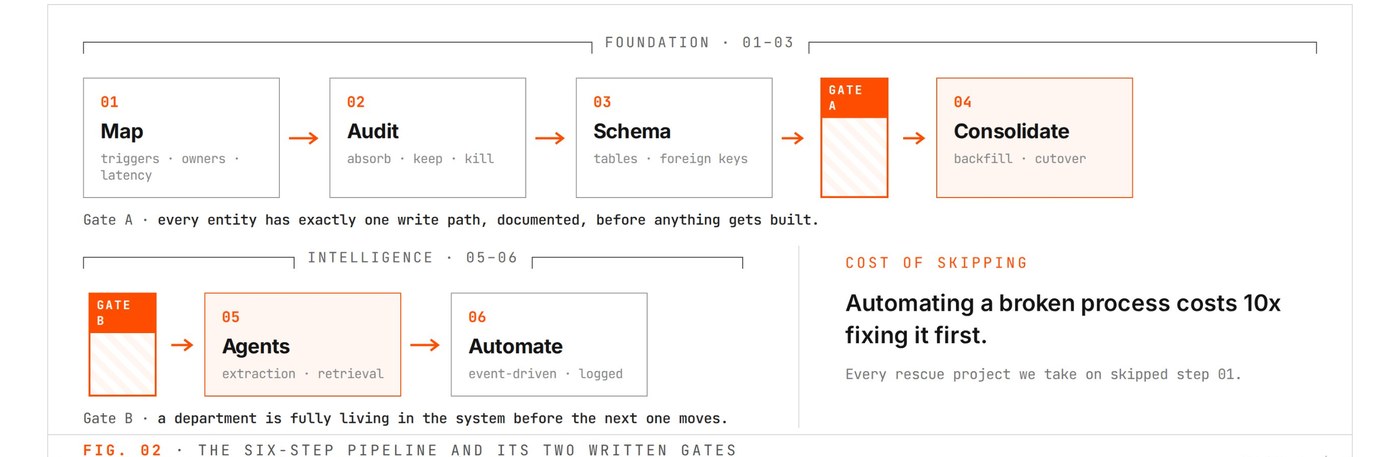
Boom’s operating system is a consolidation method: six gated phases, one source of truth, then four agents that all read and write the same tables.
Every department reads and writes one database. Shared keys. Row-level permissions. Full-context retrieval.
Value proposition 01 · The foundation
A workflow is anything that happens more than once a week. Instrument each one: trigger, steps, owner, handoff latency, and where the same data gets keyed twice. Timed manual hours become the ranking function for the entire build — they price the ROI before a dollar gets spent.

Value proposition 02 · The foundation
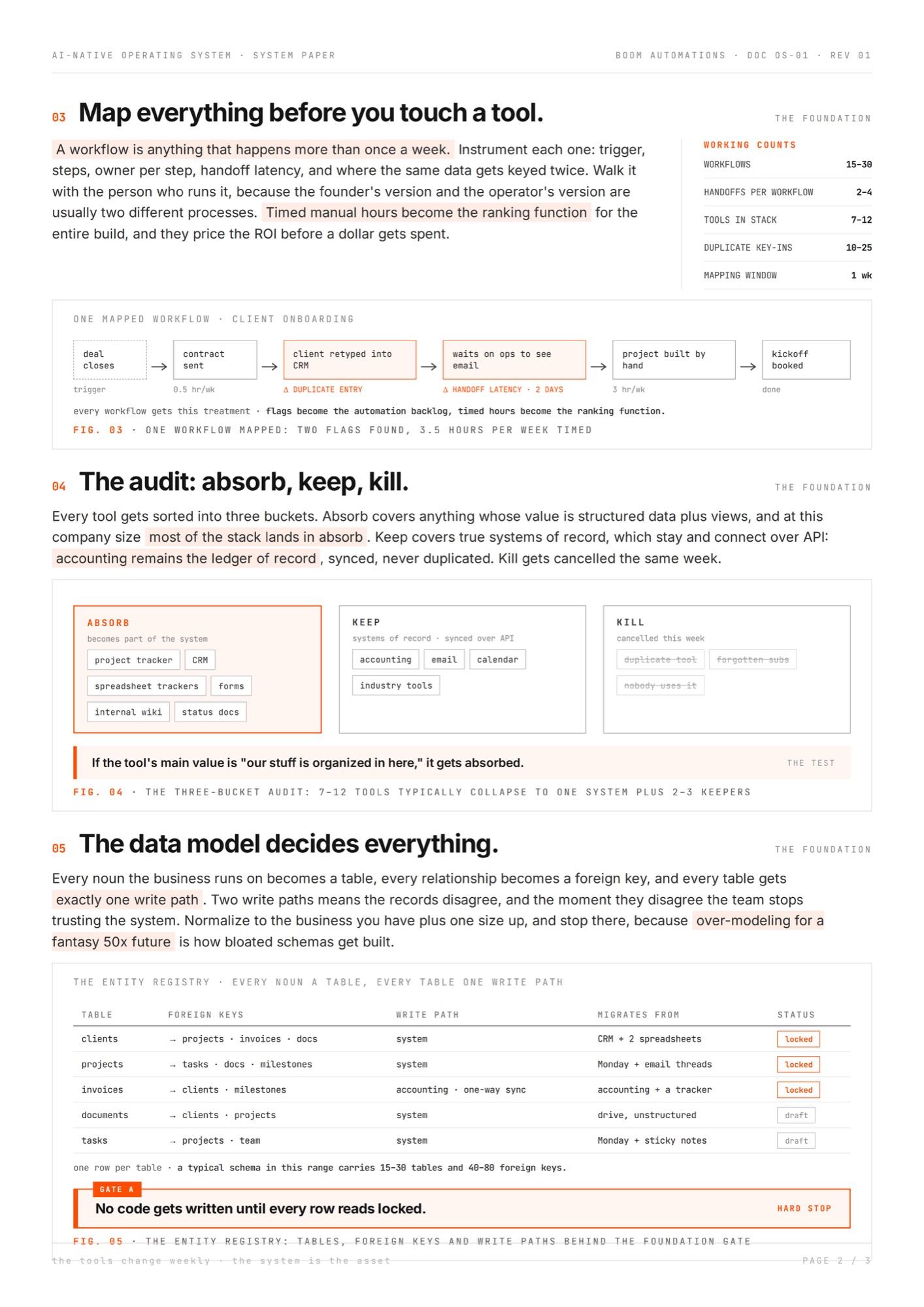
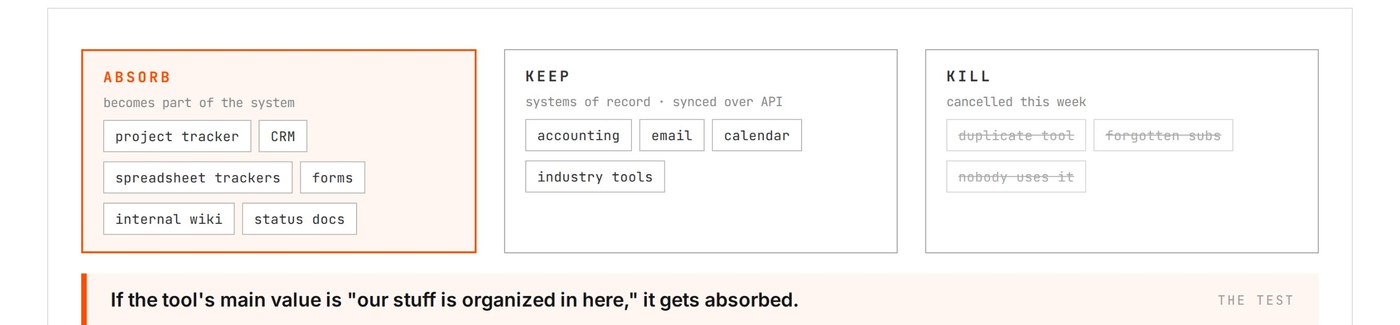
Every tool is sorted into three buckets. Absorb anything whose value is “our stuff is organized in here.” Keep true systems of record and sync them over API. Kill the rest the same week. Then every noun becomes a table, every relationship a foreign key, and every table gets exactly one write path. No code is written until every row reads locked.
Value proposition 03 · The intelligence
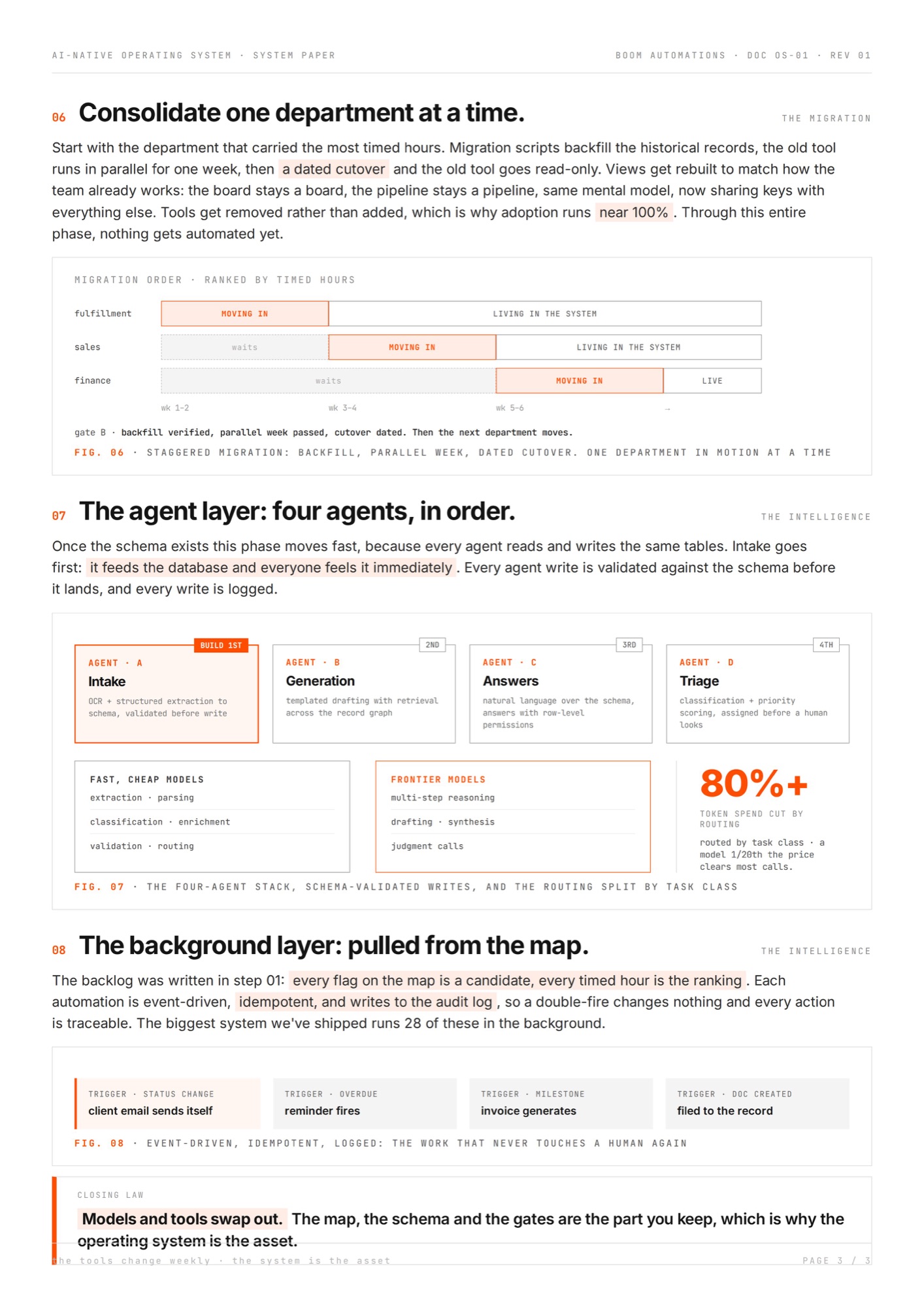
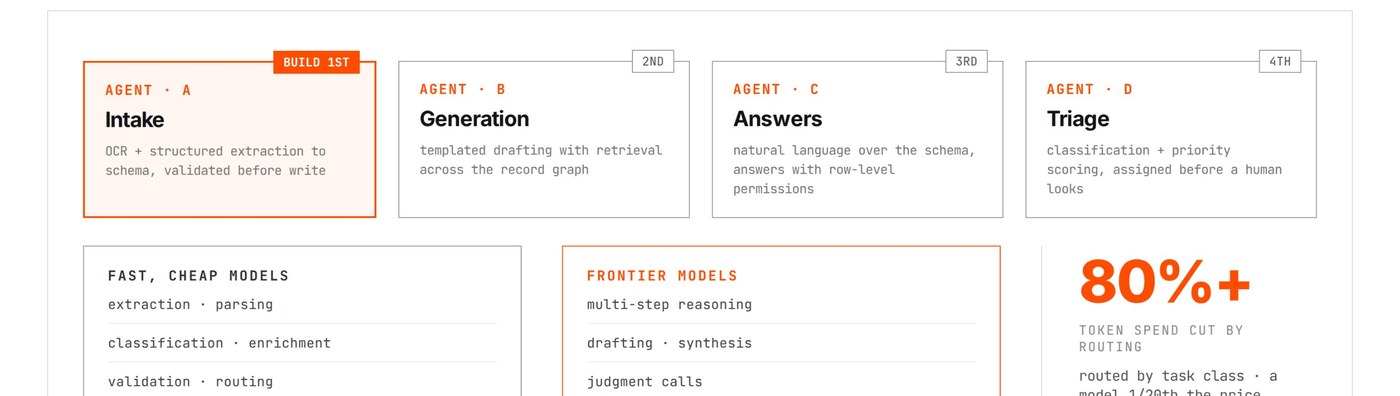
Once the schema exists this phase moves fast, because every agent reads and writes the same tables. Intake feeds the database so everyone feels it immediately. Simple tasks go to cheap models. Frontier models are saved for reasoning. That routing split is how token spend drops 80%+.
The build order
The sequence is the whole game. Foundation closes before anything gets built, and a step exits only through a written gate. Consolidate one department at a time. Automate nothing yet.
Triggers, owners, latency. Time the manual hours.
Absorb · keep · kill. Collapse the stack on paper.
Tables and foreign keys. One write path, in writing.
Backfill, parallel week, dated cutover. One department.
Intake first, then generation, answers, triage.
Event-driven, idempotent, logged. Pulled from the map.

No code gets written until every row in the registry reads locked.
Backfill verified, parallel week passed, cutover dated. Then the next department.
The map, the schema and the gates are the part you keep, which is why the operating system is the asset.
The giveaway
This is the internal doc Boom uses on every $25–$60K operating system build. Click a page to open it large. Source: Luke Pierce, 17 Aug 2026.
FAQ
Companies doing $2M–$10M a year. The paper is written for that range: 15–30 workflows, 7–12 tools, one department moving at a time.
No. Consolidate one department at a time. Automate nothing yet. Through the entire migration phase the old tool runs in parallel for one week, then a dated cutover, and the old tool goes read-only.
Those stay. Keep covers true systems of record, synced over API — accounting remains the ledger of record, synced, never duplicated. If a tool’s main value is “our stuff is organized in here,” it gets absorbed.
Intake writes into the schema, so everyone feels the new system immediately. Generation, answers, and triage only work if they read and write the same tables. Every agent write is validated against the schema before it lands, and every write is logged.
Route extraction, parsing, classification, enrichment, validation, and routing to cheap models. Save frontier models for multi-step reasoning, drafting, synthesis, and judgment. A model at 1/20th the price clears most calls.
The post names the internal doc as the one used on every $25–$60K operating system build. This page is the paper, not a checkout. Talk to Luke if you want the build done for you.
Next step
The full paper is above. If you want the $25–$60K build done on your company — map, schema, one department at a time, four agents in order — talk to Luke.